The Living Qubit: AI in Quantum Biology and the Secrets of Living Systems
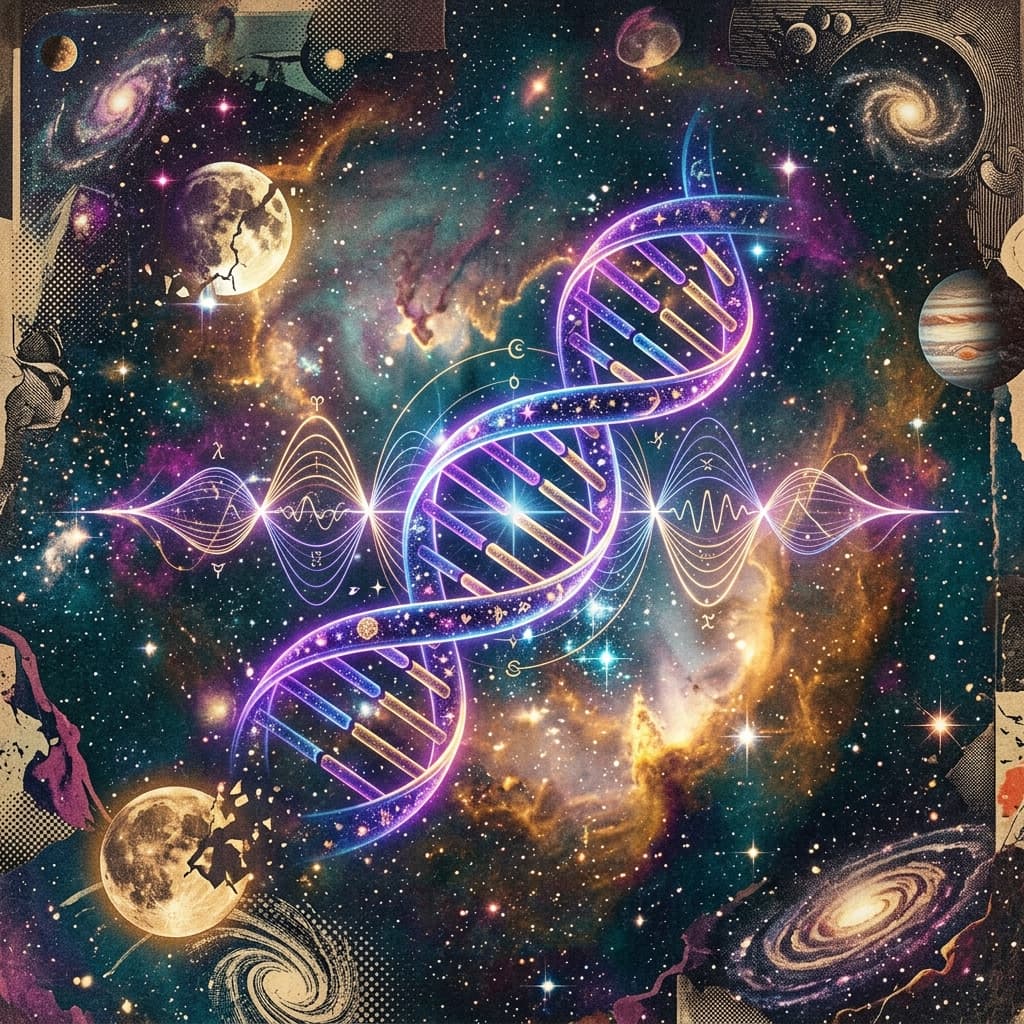
Classical biology has long treated living organisms as molecular machines operating purely under the laws of Newtonian physics—chemical reactions, electrical impulses, and thermodynamic gradients. But over the last decade, a revolutionary field has emerged that proves this model is incomplete: Quantum Biology.
Evidence now suggests that the most fundamental processes of life—from photosynthesis to bird migration to the very act of smelling—exploit quantum mechanical phenomena like superposition, tunneling, and entanglement. The problem is that quantum effects in warm, noisy biological environments are extraordinarily fleeting and difficult to measure. This is precisely where artificial intelligence enters the picture.
1. Decoding Quantum Photosynthesis
Plants convert sunlight into chemical energy with an efficiency that approaches 95%—a number that humbles the best human-engineered solar panels.
- Mapping the Exciton Highway: Scientists have long suspected that photosynthetic complexes in algae and cyanobacteria use quantum coherence to find the most efficient energy transfer pathway. An absorbed photon creates an "exciton" that must navigate a complex protein scaffold to reach the reaction center. AI models trained on femtosecond spectroscopy data have now confirmed that the exciton simultaneously explores all possible pathways at once through quantum superposition, collapsing into the most efficient route. By reverse-engineering this quantum trick computationally, AI is helping material scientists design bio-inspired solar cells that could shatter current efficiency records.
2. The Quantum Compass in Bird Navigation
European robins migrate thousands of miles with pinpoint accuracy, navigating by sensing Earth's magnetic field. The leading theory involves a quantum effect in a protein called cryptochrome, found in their retinas.
- Simulating Radical Pair Dynamics: When a photon strikes a cryptochrome molecule, it produces a "radical pair"—two electrons whose spins are quantum-entangled. The angle of Earth's magnetic field influences how fast these entangled spins oscillate, and the bird's neural system reads this signal as a kind of visual magnetic overlay. Simulating this process classically would take centuries. AI-accelerated quantum chemistry models can now simulate the full radical-pair reaction in milliseconds, validating the theory and opening the door to bio-inspired quantum sensors for GPS-free navigation in submarines, underground vehicles, and spacecraft.
3. Quantum Tunneling in Enzyme Catalysis
Enzymes—the molecular machines that power every chemical reaction in your body—work faster than classical chemistry can explain.
- Proton Tunneling and Drug Design: AI analysis of enzyme kinetics has confirmed that hydrogen atoms in many enzymes don't climb over the energy barrier of a chemical reaction; they quantum-tunnel through it. This makes certain enzymatic reactions up to 1,000 times faster than classical physics would predict. Understanding which enzymes exploit tunneling—and precisely how—is now a core focus for AI-driven drug discovery. By designing pharmaceutical molecules that enhance or inhibit specific tunneling pathways, AI is enabling an entirely new class of drugs that work at the quantum level of biology.
Life at the Quantum Edge
The discovery that life itself is a quantum technology rewrites the textbook on what it means to be a living organism. We are not just bags of classical chemicals; we are quantum machines operating at the ragged edge of physics.
At ZharfAI, we believe that intelligence—whether biological or artificial—emerges at the intersection of complexity and computation. By using AI to decode the quantum secrets of life, we are not just understanding biology; we are learning the deepest language of the universe.