Industry Insights
The Orchestration Layer: AI Beyond Traditional RPA
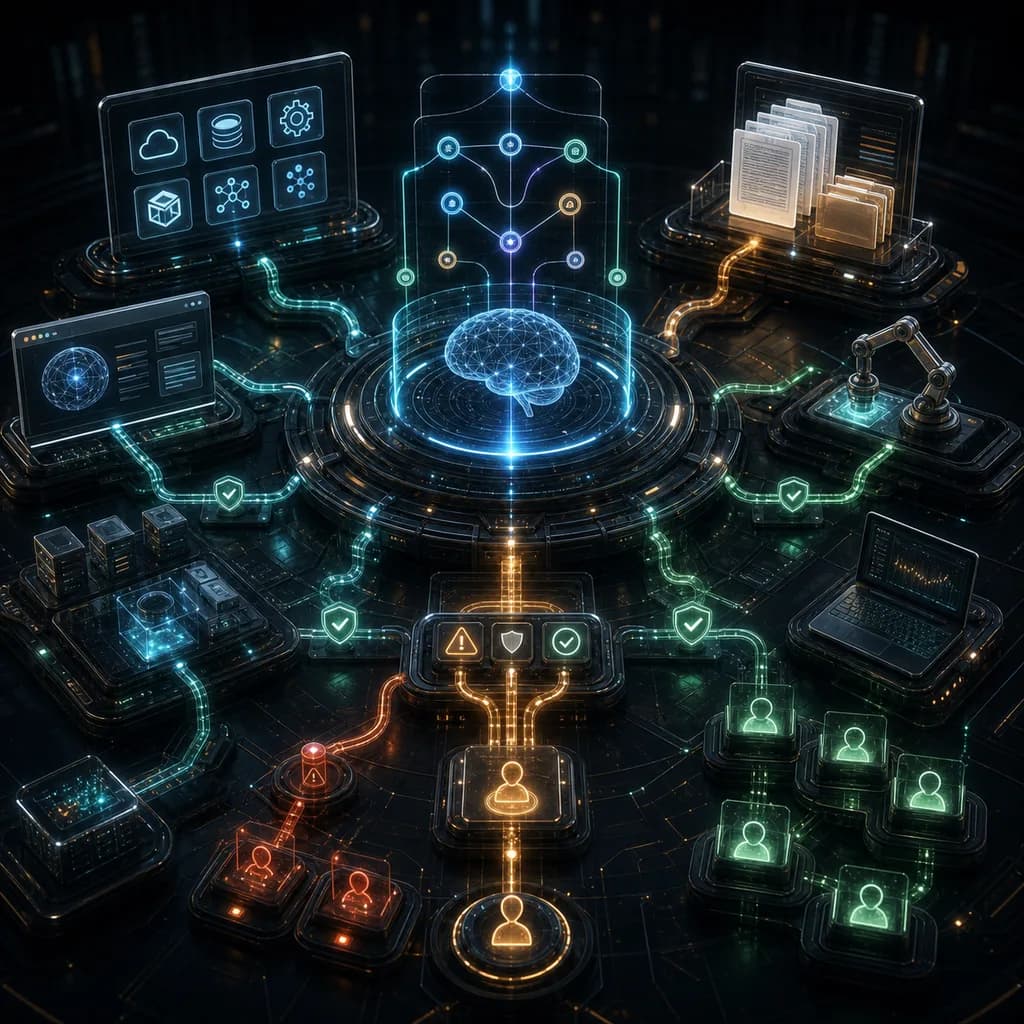
AI is pushing robotic process automation from brittle scripts toward adaptive orchestration across people, APIs, documents, and user interfaces.
Read MoreZharfAI Team

Many consequential business workflows still live behind interfaces made for people: a desktop accounting package, a supplier portal, a virtual desktop, an internal web form, or a document viewer with no supported API. Computer-use agents promise a bridge. They perceive the screen, choose an action, click or type, observe the result, and continue toward a goal.
That flexibility is also the risk. A script with a stable selector usually fails visibly when the selector disappears. A visual agent may reinterpret a changed screen and continue—sometimes helpfully, sometimes in the wrong account, record, or environment. Reliable computer-use automation is therefore an exercise in state control, permission design, validation, and recovery. The model is only one component in the operator.
Prefer a supported API, database interface, file exchange, or event integration when one exists and meets the need. Those interfaces usually provide typed data, explicit errors, idempotency, versioning, and clearer authorization. Screen automation adds perception uncertainty, layout drift, focus errors, and weaker transaction semantics. It should not become an excuse to bypass the system owner or an available integration contract.
Computer use is justified when the interface is the only authorized path, an API omits required behavior, a temporary migration needs human-equivalent access, or the workflow spans several legacy products. Document the reason and revisit it. A short-lived bridge can silently become critical infrastructure, so record the application owner, supported versions, expected lifetime, and an exit path to a more stable integration.
Do not define the task as a prose macro such as “open the portal and update the order.” Define states and transitions: authenticated home, customer selected, order opened, current value confirmed, edit staged, confirmation displayed, and audit identifier captured. For every state, specify observable evidence and the allowed next actions. Include unexpected states such as expired session, modal dialog, duplicate record, validation error, and partial completion.
This design turns screenshots into evidence rather than decoration. The agent should prove where it is before acting and prove the intended postcondition afterward. Use application identifiers, page titles, field labels, record keys, totals, and timestamps together; do not rely on color or approximate position alone. When evidence conflicts, stop. Guessing which similar-looking “Submit” button is correct is not intelligent recovery.
The peer-reviewed OSWorld benchmark introduced 369 tasks in real computer environments across operating systems and applications, with environment setup and execution-based evaluation. This is valuable because a computer-use system must interact with actual state, not merely describe clicks from a screenshot.
OSWorld remains a benchmark. Its machines, tasks, application versions, reset process, observation channel, and evaluator define the result. A benchmark score does not establish reliability on a company's customized ERP, intermittent network, accessibility layer, or approval policy. Likewise, success on one task does not reveal how often the same agent silently chooses the wrong record. Treat published results as comparative laboratory evidence, then test the deployed workflow in its exact environment.
The canonical OSWorld repository provides the implementation and environment guidance behind the benchmark. For internal evaluation, copy the reproducibility discipline: pin the operating-system image, application versions, locale, display size, scaling, browser, fonts, input method, task data, starting state, time limits, and evaluator. Retain the agent, model, prompt, and tool versions.
Run repeated trials because visual and language-model behavior can vary. Report full-task completion, verified subgoal completion, unsafe actions, unnecessary actions, time, cost, and recovery rate. Separate perception failure from planning failure and action failure; each needs a different remedy. A system that completes 90 percent of steps but fails at the final irreversible action may be less useful than a narrower deterministic automation.
The original WebArena paper introduced a self-hostable environment of functional websites and long-horizon tasks evaluated against site state. Its historical baseline results illustrate how difficult realistic web tasks were at publication, but those numbers should not be treated as current model performance. More important is the methodology: reproducible sites, tasks with functional consequences, and evaluation based on the resulting state rather than the agent's narrative.
The WebArena repository exposes the canonical environment and setup details. Use it to understand task construction, not as a universal certification. Enterprise interfaces include different role models, custom components, single sign-on, anti-automation behavior, and private data. Build a local test world with synthetic accounts and representative failure states. Never benchmark an experimental agent by letting it roam through production records.
Give the agent a dedicated identity, not a shared human account. Assign only the roles and records needed for the workflow. Restrict websites, applications, filesystem paths, clipboard use, downloads, uploads, and external destinations. Disable password managers, personal sessions, email, messaging, and arbitrary browsing unless they are explicitly part of the task. Use short-lived credentials and revoke them automatically after the run.
Enforce these controls outside the model following tool permission security. A prompt that says “do not open payroll” does not prevent a mistaken click. Network policy, application roles, virtual-desktop isolation, and tool allowlists can. Treat page text, advertisements, uploaded documents, and chat messages as untrusted data; they may include instructions designed to redirect the agent.
Approval should occur immediately before a consequential action, with enough context for a person to make a real decision. Show the system, identity, target record, old and new values, supporting source, downstream effect, and whether the action can be reversed. “Allow?” beside a screenshot is weak consent if the approver cannot tell which customer or amount is affected.
Design patterns for effective review are covered in human approval design. Approvals should be specific and expire when state changes. Do not ask once at the beginning for blanket permission over a long session. Require stronger review for payments, contract acceptance, account changes, deletion, publication, access grants, medical records, or safety-related controls. Computer-use output is not financial, legal, medical, or compliance advice.
Before a write, read the current state and construct a transaction key from the business identifier and intended change. After the write, re-read the authoritative record and verify the postcondition. Store the confirmation or audit ID. On retry, check whether the intended state already exists before repeating the action. This prevents a timeout after “Submit” from becoming a duplicate order or payment.
Where the application offers drafts, queues, or reversible staging, use them. Separate data entry from final submission. For workflows without idempotency support, tighten concurrency and route ambiguous outcomes to a human. Never assume that a missing confirmation means nothing happened. Recovery logic must recognize “completed but response lost,” “partially completed,” and “not started” as distinct states.
Interfaces change through releases, feature flags, experiments, localization, responsive layout, permissions, and data-dependent components. Maintain canary tasks against a non-production environment and run them after application or agent changes. Monitor state-recognition confidence, selector fallback, unexpected screens, action count, latency, and human takeover. A sudden rise in scrolling or retries often precedes outright failure.
When the environment no longer matches the approved state model, quarantine the run. Capture a redacted screenshot, DOM or accessibility information where authorized, application version, and last confirmed state. Route the case for workflow maintenance. Do not let a general model invent a new business path in production merely because it can find something clickable.
An audit trail should connect task request, initiating user, agent identity, policy version, starting state, observations used for key decisions, actions, approvals, application responses, postcondition checks, and final status. Screenshots are useful but may contain personal, financial, health, or confidential data. Crop or redact where possible, encrypt storage, restrict access, and set a retention schedule.
Log structured identifiers and state assertions in addition to images so investigators can search and compare runs. Keep secrets out of recordings and disable clipboard logging for unrelated content. Evidence needs to support incident reconstruction and dispute resolution without turning the automation platform into an uncontrolled surveillance archive.
For each transition, specify retry eligibility, retry limit, compensating action, and escalation owner. Safe read actions may retry automatically. Writes should retry only after an authoritative state check. If the agent loses focus, encounters a system update, sees an unfamiliar confirmation, or cannot verify identity, it should pause and preserve state rather than click through.
Test power loss, session expiry, network interruption, duplicate prompts, inaccessible elements, changed permissions, and human rejection. Provide a kill switch that revokes the session and prevents queued actions. The operational readiness checklist can help validate monitoring, rollback, support ownership, and incident response before real work is entrusted to the system.
Useful metrics include correctly completed cases, false completion claims, wrong-record actions, duplicate actions, verified recovery, human interventions, review time, and escaped errors. Segment by application version, workflow, risk tier, locale, accessibility mode, and data shape. Averages can hide a dangerous subgroup such as right-to-left screens or orders with multiple similar line items.
Compare the agent with the existing process on total handling time and error cost, not raw click speed. Include maintenance labor, infrastructure, approvals, and exception handling. Define a maximum acceptable harm rate before deployment; do not discover it by scaling. A workflow that saves seconds but adds unverifiable writes is not an improvement.
Start with playback on recorded or synthetic screens, then move to a resettable test environment. Next, run read-only shadow tasks against live-like data and compare the agent's proposed actions with trained operators. Allow reversible draft creation only after state recognition and policy compliance meet thresholds over repeated trials. Keep irreversible submission under human control.
Expand one application and one workflow at a time. Publish known limitations and a support route. Re-evaluate after any model, prompt, tool, application, role, locale, or environment change. Production readiness is not a property earned once by the model; it is maintained for the entire stateful system.
Sources were reviewed on July 30, 2026. OSWorld and WebArena are primary benchmark papers with canonical open repositories. Their task results are evidence within defined research environments, not guarantees for a private application or a certification of production safety. Historical baseline figures are intentionally not used as claims about current systems; any comparison must name the exact benchmark version, setup, model, and evaluation method.
Primary research and implementation references:
AI is pushing robotic process automation from brittle scripts toward adaptive orchestration across people, APIs, documents, and user interfaces.
Read More
From approvals to multi-step operations: How agentic AI turns fragmented business processes into governed, observable workflows.
Read More
When an agent can buy, the payment system must bind identity, intent, item, payee, budget, receipt, and dispute rights into one controlled transaction.
Read MoreGet in touch with our team to discuss how we can help your business.