
Industry Insights
The Decision Room: AI in Executive Decision Intelligence
A governance-focused guide to using AI for evidence, scenarios, dissent, board briefs, and decision follow-up without outsourcing executive judgment.
Read MoreZharfAI Team
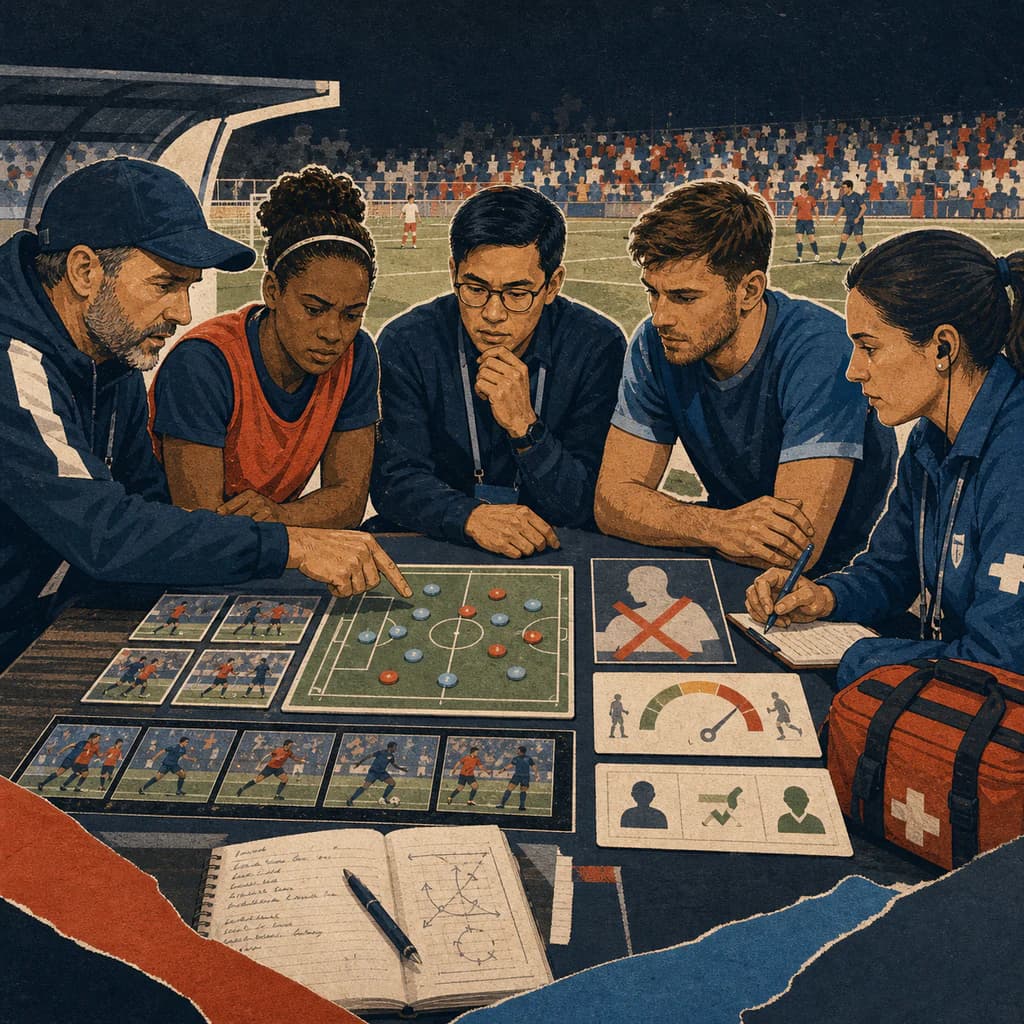
Sports analytics can help an athlete understand training, a clinician organize evidence, and a coach compare tactical choices. It can also turn a person’s body, health, movement, and livelihood into a continuous workplace surveillance stream. The difference is not the sophistication of the model. It is whether measurements are valid for the use, athletes have meaningful rights, uncertainty is visible, and consequential decisions remain accountable.
In 2026, the strongest programs do not promise to “prevent injury” or discover talent objectively. They define narrower tasks, test them prospectively, protect medical information, and measure whether support improves without coercion or exclusion.
Before collecting a signal, state who makes the decision and who may see the result. A sports scientist may need training-load summaries; a clinician may need health history; a coach may need availability, not a diagnosis. Executives, sponsors, scouts, and platform vendors do not automatically need either.
Consent is complicated by power. An athlete may technically agree while selection, employment, scholarship, or playing time depends on participation. Contracts and team policies should define required and optional collection, purpose, access, retention, secondary use, transfer between clubs, research use, commercial use, and deletion. Youth athletes need age-appropriate explanation and guardian processes without erasing the young person’s voice.
The World Anti-Doping Agency privacy standard addresses personal-information protection in the anti-doping context. It is not a universal sports-data law, but it demonstrates that purpose, proportionality, security, retention, and participant rights matter in a high-stakes sporting system.
GPS, local positioning, optical tracking, inertial sensors, force platforms, heart-rate devices, and video-derived pose all have error. Accuracy changes with velocity, direction, occlusion, venue, satellite geometry, clothing, mounting, firmware, sampling rate, and processing choices. A model cannot recover truth that the measurement never captured.
Document device, version, placement, calibration, sampling, missingness, synchronization, transformation, and unit. Test reliability and agreement for the exact sport, movement, environment, and population. Do not substitute correlation with another device for validation against a suitable reference.
FIFA’s Electronic Performance and Tracking Systems quality programme publishes a testing framework for tracking technologies, including performance and safety considerations. A device’s test result applies to its evaluated configuration and use; it does not validate every metric derived later.
Injury analytics begins with definitions. What counts as an injury, illness, recurrence, aggravation, time loss, medical attention, severity, and exposure? If clubs or seasons encode these differently, a larger dataset can be less comparable rather than more informative.
The IOC consensus statement on recording and reporting epidemiological data on injury and illness in sport provides standardized recommendations through the STROBE-SIIS framework. Teams should preserve the original clinical record while deriving analysis fields, document rule changes, and audit agreement among recorders.
Training exposure needs context: session duration, intensity, competition, travel, surface, position, phase of season, and return-to-play status. Missing sessions must not silently become zero load. Self-reported sleep, soreness, mood, or menstrual information should remain voluntary and access-controlled, with a clear clinical or performance purpose.
An injury-risk model estimates an association or probability under its data and assumptions. It does not know that an individual will be injured, and a low score is not medical clearance. “AI injury prevention” overstates the evidence when the actual intervention, adherence, and causal mechanism have not been tested.
A recent prospective study of machine-learning injury risk in professional football followed 312 male professional footballers across six European clubs in the 2022–2024 seasons. It is useful original validation evidence, but its population and setting are narrow. Results should not be generalized automatically to women, youth, para athletes, amateur players, other sports, or other calendars.
Report calibration, sensitivity, specificity, precision, lead time, confidence intervals, and decision thresholds by relevant subgroup. Compare with a clinician or simple baseline. Most importantly, prospectively test the care pathway: who receives an alert, what they do, whether training changes, and whether athlete outcomes improve without unnecessary restriction.
Models can organize imaging, history, workload, symptoms, and examination findings. They should not diagnose, clear return to play, or determine selection on their own. The clinician integrates evidence; the athlete participates in the decision; and uncertainty, competing risks, and individual goals remain visible.
Separate medical and performance data stores. Coaches may receive a carefully defined availability status or restriction, while detailed diagnosis and mental-health information remain within the clinical team. Log access and challenge informal exports through spreadsheets, chat groups, or screenshots.
This is consistent with the caution required in AI for sports biotechnology and performance: biological measurements can guide inquiry, but they do not eliminate variation, measurement error, or the athlete’s right to refuse an intervention.
Workload dashboards can combine external load, internal response, schedule, recovery, and athlete feedback. Ratios and composite scores are summaries, not universal thresholds. Their meaning depends on sport, role, phase, history, and measurement consistency.
Show the underlying observations and change over time. Let athletes annotate travel, illness, equipment, unusual drills, device failure, and how they felt. A disagreement is useful evidence, not noncompliance. Coaches should explain how a recommendation affects the plan and record why they override it.
Avoid round-the-clock surveillance that extends into private life without necessity. Sleep and location collection should be optional where possible, coarse enough for the purpose, and retained briefly. On-device calculation can reduce transfer for suitable features; the controls described in AI and on-device privacy still require clear purpose, security, and deletion.
Computer vision and event data can describe formations, spacing, pressure, passing options, possession chains, and opponent patterns. These outputs depend on provider definitions, tracking quality, and tactical context. A pattern observed in past matches may disappear under a new lineup, coach, score state, or competition.
Analysts should expose sample size, match context, missing periods, and uncertainty. Compare model findings with video and domain review. Prevent leakage from post-match labels into pre-match models. For live use, test latency and failure modes; an insight delivered after the tactical window is operationally useless.
Keep coaches and players in the loop. The model can surface clips and alternatives, while people interpret intent, deception, fatigue, and match dynamics. Measure decision usefulness and analyst time, not the quantity of automated insights.
Talent data reflect unequal access to coaching, facilities, minutes, competition, nutrition, and visibility. Youth performance is strongly affected by maturation and relative age. A model trained on people already selected into elite pathways learns the pathway’s filters as well as sporting potential.
Do not use a score to close a pathway. Use multiple observations, uncertainty, and human review; allow athletes to correct identity and performance records. Audit recommendations by age, gender, geography, disability, position, competition level, and socioeconomic proxies where lawful and meaningful.
Evaluate whether the system expands discovery or simply repeats historic recruitment. Track false exclusion and later development, not only whether selected athletes succeed. Scouts should see evidence and alternative explanations rather than a ranking without context.
Tracking and vision can support line decisions, event detection, and replay selection. Because officiating affects competition legitimacy, the system needs sport-specific testing, timing synchronization, known tolerance, failover, and a clearly identified human authority.
Display the relevant evidence rather than only a colored verdict. Define what happens when cameras disagree, calibration fails, a player is occluded, or the decision arrives late. Appeals and post-event review should preserve logs and model version.
Technology can standardize some observations; it cannot remove interpretive rules or every edge case. Governing bodies should publish the decision protocol and meaningful performance evidence so participants understand the system.
Athlete health and tactics are valuable to opponents, gamblers, media, sponsors, insurers, and criminals. Apply strong identity, least privilege, encryption, device management, network segmentation, vendor review, and monitoring. Separate public fan analytics from confidential performance systems.
Threat-model compromised wearables, malicious video, poisoned labels, account takeover, insider export, ransomware, and model extraction. Sign device and model updates. Maintain an offline plan for training and competition when analytics are unavailable.
Control vendor access and prohibit unapproved reuse for general model training. Contracts should specify breach notice, sub-processors, data location, deletion, audit, model updates, and what happens when an athlete or team leaves.
The IOC’s Olympic AI Agenda presents potential uses and governance considerations for AI across sport. Any organization adapting such possibilities must still translate principles into sport-, jurisdiction-, and role-specific controls.
Create a system register containing purpose, owner, data, lawful basis or consent mechanism, affected athletes, model and device versions, validation scope, user interface, thresholds, access, incident history, and retirement plan. An independent group with athlete representation should review high-impact uses.
Commercial partnerships deserve a bright line. Performance or biometric data collected for care and training should not silently become sponsorship targeting, betting content, contract leverage, or insurance input. New purposes require a fresh assessment and, where appropriate, genuinely optional agreement.
Start in shadow mode with a narrow question and a pre-registered evaluation. Compare against current practice, document data gaps, and have clinicians, coaches, analysts, and athletes review false positives and false negatives. A retrospective dashboard can look impressive while failing under live workflow.
Pilot with an escalation and appeal path. Define when the model must abstain, what evidence a user sees, and how an athlete can challenge a record. Monitor workload: an alert system that overwhelms staff can make care worse.
Measure sensor availability and error, calibration, injury definitions, alert precision, lead time, intervention adherence, days lost, reinjury, unnecessary restriction, athlete understanding, consent withdrawal, access violations, override, appeal reversal, subgroup performance, and user workload.
AI should help athletes and professionals ask better questions, not turn uncertain measurements into unquestionable authority. The competitive edge worth keeping is a healthier, better-informed decision process in which the athlete remains a participant rather than the product.
Sources and links were reviewed on July 30, 2026:
A governance-focused guide to using AI for evidence, scenarios, dissent, board briefs, and decision follow-up without outsourcing executive judgment.
Read More
A practical 2026 guide to cryptographic inventory, NIST post-quantum standards, AI-assisted discovery, crypto agility, migration priorities, and release evidence.
Read More
AI can help teams detect schema drift, metric anomalies, missing context, and broken pipelines before bad data reaches decision makers.
Read MoreGet in touch with our team to discuss how we can help your business.