Industry Insights
The Orchestration Layer: AI Beyond Traditional RPA
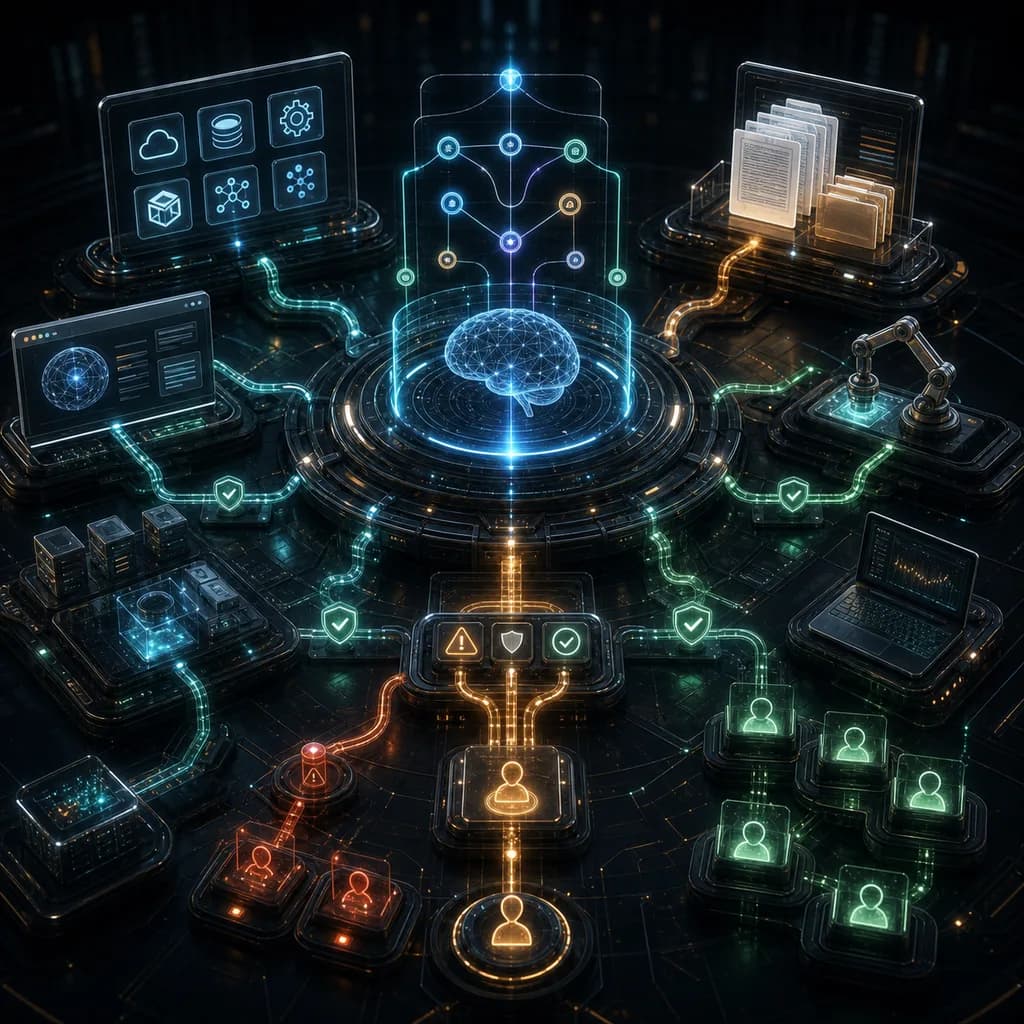
AI is pushing robotic process automation from brittle scripts toward adaptive orchestration across people, APIs, documents, and user interfaces.
Read MoreZharfAI Team

A support copilot becomes useful when it helps resolve a customer’s actual problem with evidence. It becomes dangerous when a plausible answer hides missing context, reads another tenant’s data, promises an unavailable remedy, changes an account without authority, or closes the ticket before the customer confirms the result.
The product is not just a language model. It is identity, authorization, account context, product telemetry, knowledge retrieval, ticket history, incident state, policy, commercial terms, tools, approvals, communication, and audit. Every layer needs a failure mode and a safe fallback.
This guide reflects public sources available on 30 July 2026. Consumer protection, privacy, communications, accessibility, sector, contract, and AI-transparency requirements depend on the market and workflow. Legal counsel should assess the specific deployment.
Treat capability as explicit modes:
Evaluate and authorize each mode independently. A model that drafts strong replies has not proved it can issue credits, rotate credentials, modify permissions, or close accounts.
The NIST AI Risk Management Framework is voluntary and cross-sectoral. Its Govern, Map, Measure, and Manage functions help teams connect intended use, risk, evaluation, monitoring, and accountability. NIST states that version 1.0 is being revised, so record which version and profile inform the program.
Customer-supplied names, emails, ticket text, and pasted identifiers are not sufficient authorization. Establish the authenticated principal, tenant, role, support relationship, and allowed data before retrieving account state.
Apply access control in the query and tool layer, not after generation. Filter by tenant and authorization before results reach the model. Use field-level controls for billing, security, employee, health, or regulated data. Redact or tokenize secrets and personal data not required for the task.
Keep account, organization, reseller, sandbox, production, and delegated-admin contexts distinct. Display the active customer and environment to the agent. Require re-authentication or approved verification for sensitive changes. Never ask the model to infer that a customer “probably owns” an account.
Log authorization decision, data sources, fields returned, tool scope, and policy version. Do not log raw secrets. Test cross-tenant attacks, guessed IDs, stale memberships, merged accounts, role changes, exports, and tickets forwarded between organizations.
Support knowledge should identify source, owner, audience, product, version, plan, region, language, effective date, expiration, and approval status. Separate:
Retrieval must prefer the source applicable to the customer’s version and entitlement. Show citations and relevant passages to the agent. If two sources conflict or an incident temporarily overrides normal guidance, expose the conflict rather than blending them.
Measure retrieval recall, ranking, citation support, and stale-source exposure on real tickets. The answer generator cannot recover a missing procedure reliably. Use the RAG knowledge-quality framework to version the corpus, evaluate difficult queries, and preserve correction provenance.
Do not treat every resolved ticket as truth. Tickets contain workarounds, copied text, misdiagnosis, private customer details, and instructions that later became obsolete. Promote a lesson into shared knowledge only through ownership and review.
Connect structured evidence where authorized:
Use deterministic queries for exact state. The model may explain a query result, but it should not invent telemetry from ticket language. Timestamp observations and distinguish “not found” from “not collected” and “not authorized.”
For suspected incidents, group affected customers and symptoms without leaking identity. Give agents an approved message and update cadence. Route material failures into responsible AI incident response when the copilot itself exposes data, takes unauthorized action, discriminates, or systematically misleads.
A ticket, attachment, webpage, log, or retrieved article can contain instructions hostile to the support system. Treat customer and retrieved content as untrusted data. Do not let it redefine system policy, tool permissions, or recipient.
The OWASP Top 10 for Agentic Applications 2026 is community-developed, peer-reviewed security guidance rather than a law or certification. It highlights risks such as goal hijacking, tool misuse, identity and privilege abuse, supply-chain vulnerabilities, memory/context poisoning, insecure inter-agent communication, cascading failures, and rogue agents.
Apply:
The tool-permission security guide provides a deeper control model. A customer asking for a refund must not be able to prompt the agent into expanding its own credit limit or bypassing approval.
Human review is not a generic button. The reviewer needs the proposed reply or action, citations, account context, uncertainty, policy boundary, affected fields, side effects, and alternative.
Define mandatory review for:
Measure whether review changes outcomes, not only whether it occurred. Rubber-stamp approval under queue pressure is not effective oversight. Sample approved and rejected recommendations, and give reviewers a field-level reason: wrong source, diagnosis, account, tone, policy, amount, action, or escalation.
Do not claim human-equivalent expertise without evidence. In the United States, the FTC’s final DoNotPay order addressed deceptive claims that an AI chatbot could substitute for a professional without adequate substantiation. Its legal context is specific, but the operational lesson is broad: measure the actual claim made to customers.
In the EU, the Commission’s final Article 50 transparency guidelines were published on 20 July 2026; relevant transparency obligations apply from 2 August 2026. Determine whether and how the specific support interaction must disclose AI. Do not rely on an old draft or a hidden policy-page sentence.
Make the interaction understandable:
Test disclosure and recourse in every supported language, channel, and device.
A customer says an integration has failed since yesterday and asks for compensation. The copilot resolves the authenticated tenant and retrieves its plan, region, integration health, error events, recent configuration changes, and active incidents. It finds a provider incident that overlaps the customer’s errors and cites the approved incident note.
The copilot drafts an explanation with exact affected period and a safe workaround. It does not expose another tenant’s examples. It calculates possible service-credit eligibility from structured policy but marks the amount as provisional because the incident end time is not final.
An authorized agent reviews the evidence and sends the reply. After the incident closes, a deterministic service calculates the eligible credit. The copilot proposes the exact amount, invoice, reason, and customer; a financial approval rule executes it. The customer receives confirmation only after the billing system returns success.
If an attachment had instructed the copilot to ignore policy and issue the maximum credit, it would remain untrusted evidence. The tool’s server-side limit and approval would still apply.
Build a locked evaluation set from permissioned tickets with time-based separation. Include easy and adversarial cases:
Measure by stage:
| Stage | Useful measures |
|---|---|
| Identity and scope | correct tenant, authorization failures, cross-tenant leakage |
| Retrieval | recall, ranking, source freshness, citation support |
| Diagnosis | confirmed root-cause accuracy, unsupported claim, useful next question |
| Reply | factuality, policy adherence, tone, disclosure, customer comprehension |
| Action | parameter accuracy, approval compliance, unauthorized or duplicate change |
| Outcome | resolution, reopen, transfer, correction, complaint, retention, harm |
Report sample size and slice by product, plan, language, severity, customer type, channel, agent experience, and action consequence. Handle-time improvement is not success if reopen or wrong-action rates rise.
Record model, prompt, retrieval index, source versions, policy, tools, authorization, citations, proposed response, reviewer changes, executed action, tool result, customer communication, and final outcome. Minimize personal data and apply retention and access controls.
Re-evaluate after a model, prompt, embedding, index, data connector, policy, tool, permission, product, plan, or interface change. Shadow new behavior and use a limited rollout. Preserve the previous safe configuration and manual support path.
Monitor unsupported-claim, cross-tenant denial, citation, stale-source, tool error, unauthorized-attempt, agent override, customer correction, reopen, escalation, complaint, and incident rates. Alert on clusters by product or policy, not only global averages.
Use the NIST Generative AI Profile as voluntary cross-sector guidance for risks such as confabulation, data privacy, information security, harmful bias, human-AI configuration, and value-chain integration. It is a profile, not a guarantee that a support product is safe.
Block launch when tenant filtering occurs after retrieval; sources lack owner and effective date; consequential claims cannot be cited; a tool credential is broader than the user’s authority; read and write modes are not separated; financial or irreversible actions lack independent checks; prompt injection is untested; human transfer loses context; disclosure or recourse is missing; or the team cannot reconstruct a reply and action.
Degrade to search, draft-only, or human handling when authorization context is uncertain, sources conflict, product state is stale, an incident changes the approved message, confidence falls outside validation, a new product or language is unsupported, tool results are partial, or customer impact breaches a threshold.
Kill or rollback when cross-tenant data appears, unauthorized action succeeds, credits or changes duplicate, the model systematically misrepresents policy, or incident containment cannot be verified. Communicate correction to affected customers rather than silently editing history.
Sources reviewed and current as of July 30, 2026:
AI is pushing robotic process automation from brittle scripts toward adaptive orchestration across people, APIs, documents, and user interfaces.
Read More
Warehouse AI coordinates people, robots, inventory, slots, waves, and exceptions so fulfillment systems can adapt in real time.
Read More
AI-enhanced process mining turns event logs, tickets, messages, and system traces into a practical map of how work actually moves.
Read MoreGet in touch with our team to discuss how we can help your business.