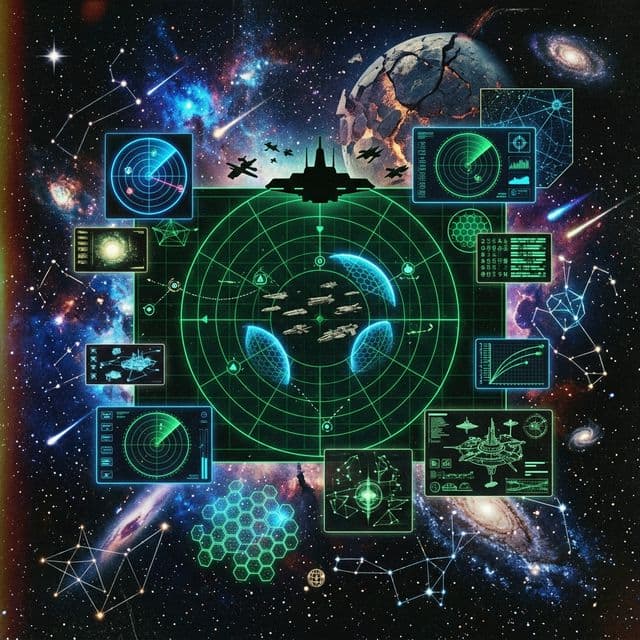
The All-Seeing Eye: Palantir and the AI Data Fusion Revolution in Modern Conflicts
In the chaotic theater of modern warfare, data is as lethal as ammunition. The U.S. military and its allies collect an unimaginable amount of information every second: high-resolution satellite imagery, drone video feeds, intercepted radar signals, and ground-level intelligence. The challenge is no longer gathering data, but making sense of it before the enemy moves.
Enter the era of "Data Fusion," pioneered by defense tech giants like Palantir Technologies. By integrating advanced machine learning and Large Language Models (LLMs) into the military kill chain, Palantir is transforming raw data into actionable, lethal intelligence in milliseconds—a capability most visibly deployed in recent Middle Eastern conflicts.
1. Project Maven and the Speed of War
The U.S. Department of Defense's Project Maven—an official program of record deeply intertwined with Palantir's AI infrastructure—was arguably the first large-scale combat operation driven and amplified by artificial intelligence.
- Algorithmic Target Identification: During recent US military airstrikes against Iranian-aligned assets, the speed of target acquisition was unprecedented. Palantir's Maven Smart System ingested diverse data streams—radar, satellite, and drone feeds—using computer vision AI to instantly identify and classify potential threats. According to reports, this allowed commanders to identify up to 1,000 targets within the first 24 hours of the offensive.
- The LLM Commander Interface: Palantir has integrated advanced generative AI, explicitly utilizing models like Anthropic's Claude, into its defense platforms. Commanders don't need to write complex database queries; they can ask the AI in plain English: "Show me all mobile missile launchers moved into the southern sector in the last 12 hours, and calculate the optimal strike package." The AI instantly synthesizes the data and presents a menu of tactical options.
2. Gotham and Foundry: The Panopticon of the Battlefield
Palantir operates two primary platforms that serve as the operating systems for modern intelligence:
- Palantir Gotham: Designed specifically for the defense and intelligence sectors, Gotham acts as a massive data fusion engine. It connects the dots between seemingly unrelated data points—a suspicious financial transaction in Europe, a cell phone pinging near a forward operating base, and a drone spotting a newly dug trench—flagging anomalies for human analysts that would take thousands of hours to piece together manually.
- Tactical Edge AI: Battlespaces often have terrible internet connectivity. Palantir pushes its AI models directly to the "tactical edge." Submarines, forward-deployed troops, and autonomous drones run these AI models locally on their hardware, allowing them to independently identify threats and share that intelligence across the network in real-time, creating a highly resilient, decentralized 'kill web' rather than a traditional 'kill chain.'
3. The Geopolitics of AI Warfare
The deployment of Palantir's systems in the Middle East underscores a critical asymmetry in modern geopolitics. While the US and Israel leverage globally dominant AI architectures—capable of processing entire battlefields in real-time—nations like Iran rely on less sophisticated, domestically developed technologies.
Though Iran has notably utilized AI for disinformation campaigns and drone reconnaissance, heavy international compute sanctions have hobbled their ability to train models matching the analytical scale of Palantir's Gotham or Project Maven, cementing a distinct technological upper hand for Western allies.
4. The Ethical Dilemma: The Human in the Loop
The efficiency of Palantir's AI target generation has triggered immense ethical and legal debates. When an algorithm recommends a weapon system to strike a target, how much genuine oversight does the human operator have?
Incidents involving severe collateral damage, such as civilian casualties in combat zones, have intensified scrutiny of algorithmic bias and the risk of "automation bias," where stressed human operators blindly trust the machine's lethal recommendations.
The Future of the Algorithmic Theater
Palantir's success proves that the ultimate weapon of the 21st century is software. By fusing the chaos of global data into a singular, crystalline view of the battlefield, AI is redefining what it means to wage war.
At ZharfAI, we analyze these paradigm shifts critically. As AI accelerates the speed of military action beyond human cognition, society must aggressively debate the boundaries of algorithmic warfare before the machine fully takes the wheel.