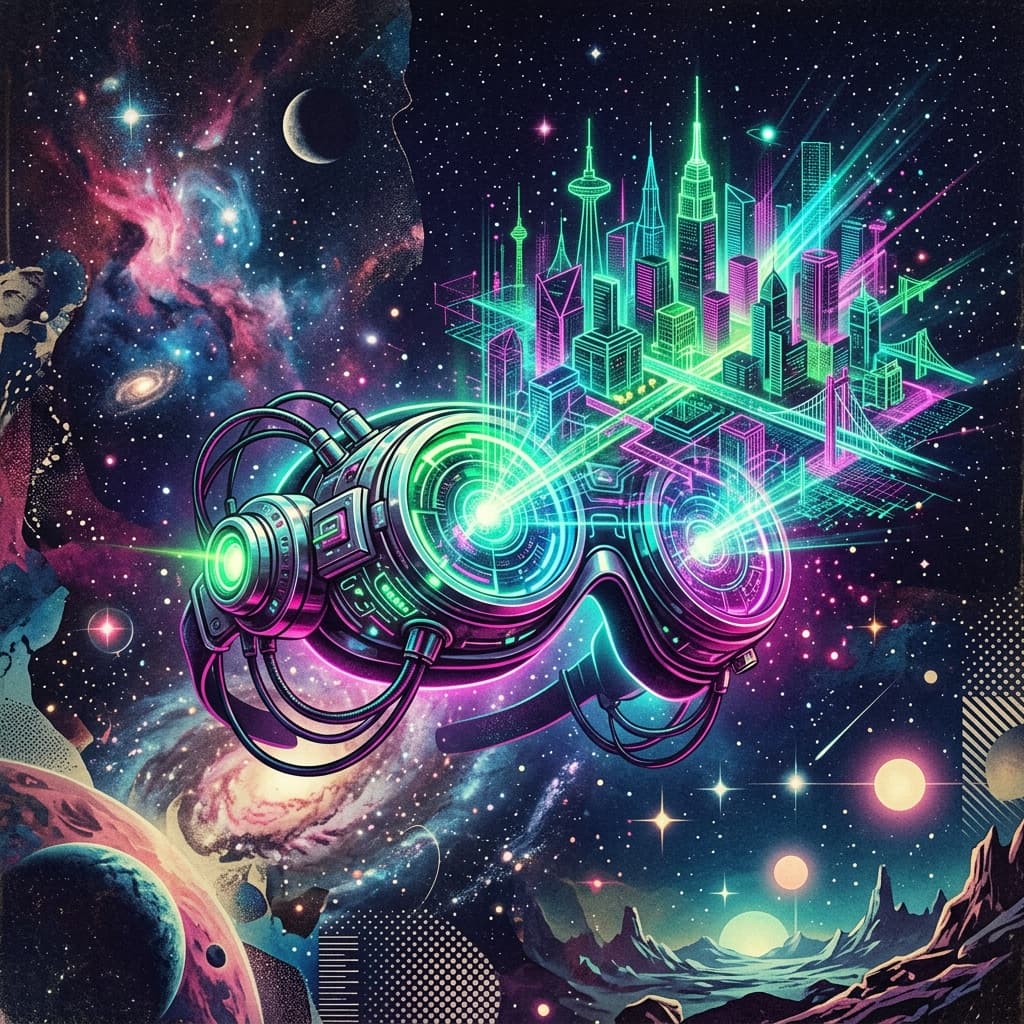
The Holographic Desk: AI in Augmented Reality and Spatial Computing
For the last forty years, our interaction with the digital world has been fundamentally constrained by two-dimensional rectangles: computer monitors, television screens, and smartphones. We look at our data, but we do not exist within it.
In 2026, the boundaries of the digital rectangle have collapsed. "Spatial Computing," powered by ultra-lightweight Augmented Reality (AR) glasses and advanced Artificial Intelligence, seamlessly blends the digital and physical worlds. AI is the essential rendering engine making this possible, allowing high-fidelity holograms to interact with real-world physics in real-time.
1. Algorithmic Environmental Mapping
For an augmented reality hologram to feel real, the computer must perfectly understand the physical geometry of the room you are standing in.
- Real-Time Mesh Generation: Early AR systems struggled with "occlusion"—a digital character would awkwardly float over a real-world couch instead of hiding behind it. Today, the embedded AI in a user's AR headset acts as a localized radar. It instantly generates a millimeter-accurate 3D mesh of the entire room, identifying walls, furniture, and even people. If you drop a digital, holographic bouncy ball onto your physical coffee table, the AI calculates the exact density of the table's surface and mathematically simulates the physics, causing the digital ball to bounce off the physical table with absolute kinetic realism.
2. The Infinite Digital Workspace
The limitations of a 15-inch laptop monitor are completely obsolete in the era of spatial computing.
- Generative UI Context: A financial analyst wearing AR glasses no longer buys a six-monitor desk setup. By pinching the air, they rely on AI to generate an infinite, floating 360-degree workspace. But the AI goes further than just rendering floating windows; it understands contextual workflow. If the analyst opens a PDF of a quarterly earnings report, the AI recognizes the intent and automatically spawns a holographic, interactive 3D bar chart of the company's historical revenue floating to the right, and a live Bloomberg news feed floating to the left, algorithmically organizing the user's workflow in physical space.
3. Telepresence and Volumetric Capture
Video conferencing platforms like Zoom feel incredibly isolating because they lack the physical presence of genuine human interaction.
- The AI Avatar: In 2026, remote workers collaborate through volumetric telepresence. A user in Tokyo and a user in London wear AR glasses and appear to sit across from each other at the same physical table. Instead of transmitting massive amounts of 3D video data (which causes latency), the system uses AI skeletal tracking. The headsets capture the microscopic facial movements and body language of the users, transmitting only the mathematical telemetry. The receiving AI then instantly generates a hyper-realistic, 3D holographic avatar of the person sitting locally. The resulting interaction has zero latency, restoring eye contact and spatial empathy to remote communication.
The World as a Canvas
We are transitioning from computing that distracts us from the real world to computing that enhances it. By integrating artificial intelligence into how we physically see and interact with data, we are turning reality itself into an infinite, programmable canvas.
At ZharfAI, we believe that technology should break down barriers, not build them. Artificial intelligence in spatial computing proves that the screen was just a stepping stone—the true future of human-computer interaction is happening outside the box.