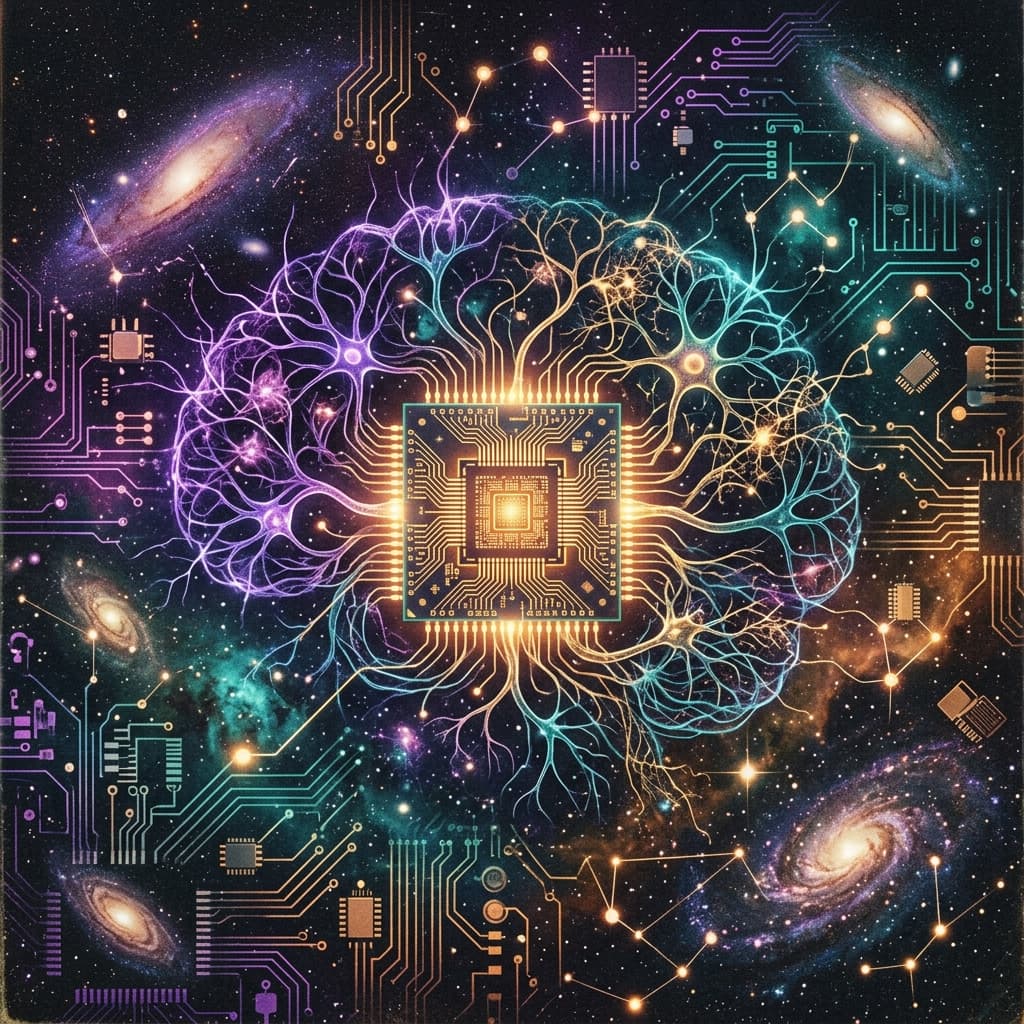
The Cryptographic Singularity: AI in Quantum Computing and Cyber Security
For the last forty years, the security of the internet has hinged on one mathematical reality: classical computers are very bad at factoring incredibly large prime numbers. The RSA encryption protecting your global banking details, military communications, and personal emails relies entirely on this computational bottleneck.
In 2026, quantum computers are no longer science fiction. While a classical computer simulates reality in strict binary 1s and 0s, a quantum computer utilizes qubits, which can exist as 1, 0, or both simultaneously (superposition). This allows quantum architecture to perform complex calculations exponentially faster. However, bridging the gap between theoretical quantum mechanics and perfectly stable hardware requires an intelligence greater than our own.
1. Algorithmic Error Correction
The primary challenge of quantum computing is "decoherence." Qubits are incredibly fragile; the slightest change in temperature or microscopic electromagnetic radiation causes them to collapse and lose their quantum state, resulting in massive computational errors.
- Quantum Neural Networks: Human physicists cannot manually calculate and correct errors happening at a sub-atomic level. We now rely on specialized AI models to act as real-time quantum noise filters. The AI continuously monitors the millions of unstable qubits, mathematically predicting microscopic environmental fluctuations and applying split-second electromagnetic pulses to stabilize the qubits before they decohere. Artificial intelligence is the essential scaffolding making large-scale quantum computing physically possible.
2. The Y2Q Crisis: Shattering RSA Encryption
When a perfectly stable, large-scale quantum computer comes online, it will run "Shor's Algorithm." This equation will allow the machine to instantly factor the massive prime numbers that secure the modern internet, shattering standard RSA encryption in minutes. This looming threat is referred to as "Y2Q."
- Store Now, Decrypt Later: Hostile state actors are already harvesting massive amounts of encrypted data from the internet today, storing it in massive offshore data centers. They know they can't decrypt it now, but they are hoarding it for the day they switch on a quantum computer.
- AI-Driven Post-Quantum Cryptography: To defend against Y2Q, cyber security firms are using generative AI to write entirely new cryptographic languages based on complex, multi-dimensional lattice structures—mathematical puzzles that even a quantum computer cannot easily solve. AI models automatically audit global bank networks, surgically removing vulnerable legacy code and replacing it with quantum-resistant algorithms overnight.
3. Quantum Machine Learning (QML)
When you combine the predictive power of Artificial Intelligence with the sheer processing power of Quantum Computing, you achieve "Quantum Machine Learning."
- Simulating the Universe: QML algorithms do not just process data sequentially; they process every possible outcome simultaneously. Instead of taking ten years to invent a new room-temperature superconductor, a QML model can simulate the quantum interaction of every known element on the periodic table simultaneously, discovering the perfect molecular structure in 48 hours.
The Next Era of Processing
We stand on the precipice of the quantum revolution. The machines being built today will make the supercomputers of 2020 look like wooden abacuses.
At ZharfAI, we believe that navigating the quantum singularity requires immense responsibility. Artificial intelligence is not just building the key to break any digital lock in the world; it is actively forging the indestructible vaults that will protect our civilization in the quantum era.