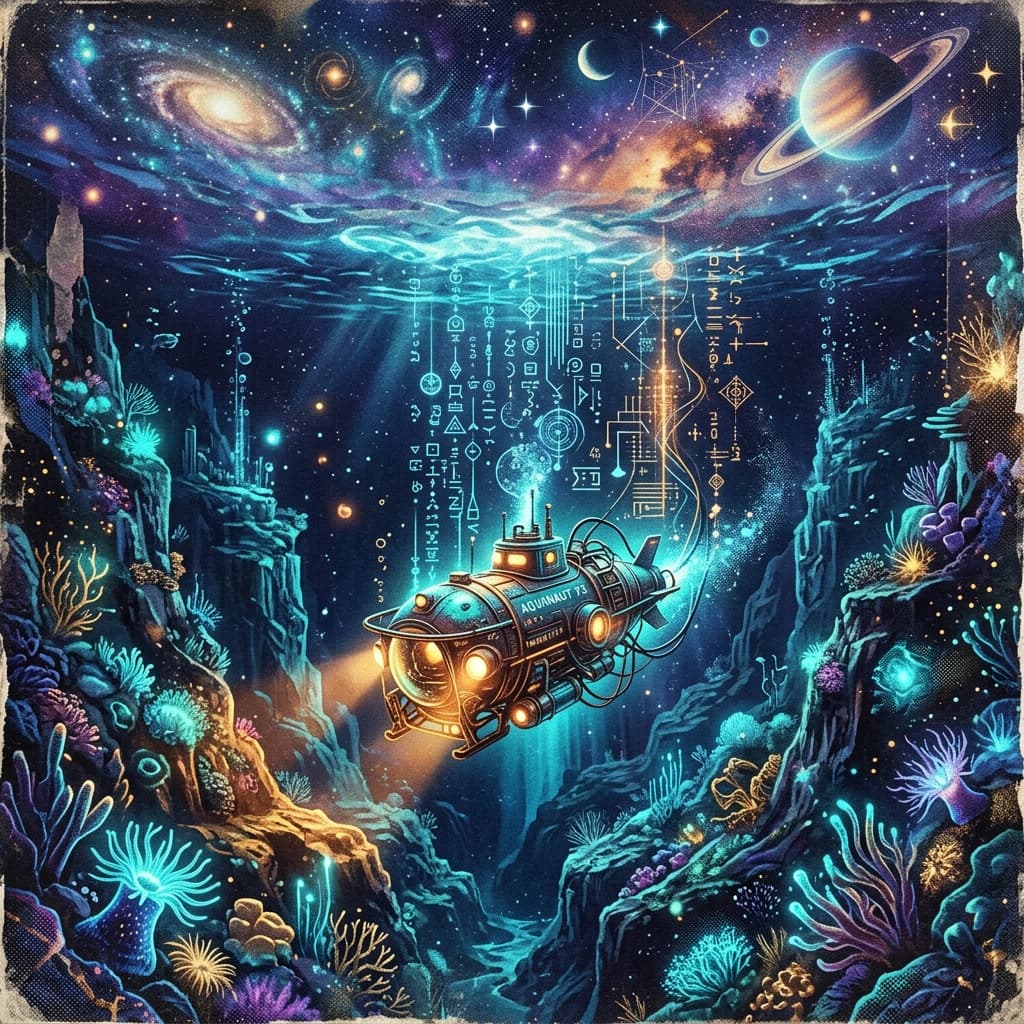
The Abyss Algorithm: AI in Ocean Engineering and Deep-Sea Exploration
Humanity has mapped the surface of Mars in higher resolution than the floor of our own oceans. Over 80% of the seabed remains uncharted, unexplored, and fundamentally unknown. The deep ocean is Earth's last true frontier—a realm of crushing pressures, perpetual darkness, and extreme temperatures that makes it more hostile to human exploration than outer space.
In 2026, artificial intelligence is finally giving us the tools to conquer the abyss. By embedding advanced AI into autonomous underwater vehicles (AUVs), distributed sensor networks, and predictive oceanographic models, we are mapping, monitoring, and engineering the deep ocean at a scale that was physically impossible just a decade ago.
1. Autonomous Bathymetric Mapping
Traditional ocean floor mapping relies on research vessels dragging sonar arrays across the surface—a process so slow that mapping the entire ocean would take roughly 1,000 ship-years at current rates.
- Swarm Cartography: Fleets of small, expendable AI-driven AUVs are now deployed in coordinated swarms. Each vehicle is equipped with multibeam sonar and a localized AI that makes real-time navigational decisions without any human input. As the swarm descends into a deep trench, the AI on each vehicle continuously shares bathymetric data with its neighbors via acoustic modem. If one AUV discovers an unexpected geological feature—a hydrothermal vent field, a previously unknown seamount—the swarm AI dynamically re-routes the entire fleet to prioritize mapping the discovery zone, generating centimeter-resolution 3D maps of terrain that no human eye has ever seen.
2. Predictive Ocean Climate Modeling
The ocean absorbs over 90% of the excess heat trapped by greenhouse gases. Understanding how deep ocean currents distribute this heat is critical to predicting global climate trajectories.
- Digital Ocean Twins: AI-powered "digital twins" of entire ocean basins now ingest real-time data from thousands of Argo floats, satellite altimetry, and deep-sea moorings. The AI simulates the thermohaline circulation—the global conveyor belt of warm and cold water that regulates Earth's climate—at a resolution of one cubic kilometer. By running millions of forward simulations, the AI can predict the precise path and timing of ocean heat redistribution decades into the future, identifying tipping points in Atlantic Meridional Overturning Circulation (AMOC) stability years before they manifest as extreme weather events on the surface.
3. Self-Healing Subsea Infrastructure
The global economy depends on a vast network of undersea cables that carry 99% of intercontinental internet traffic, and subsea pipelines that transport oil and gas across ocean floors.
- Autonomous Inspection and Repair: AI-controlled ROVs (Remotely Operated Vehicles) now autonomously patrol thousands of kilometers of subsea cable routes. The onboard computer vision system detects microscopic abrasion damage on cable sheaths, corrosion on pipeline joints, or biological fouling from deep-sea organisms. When the AI identifies early-stage degradation, it dispatches a secondary repair drone that applies a polymer sealant to the damaged section—all at depths of 3,000 meters, in complete darkness, without any human operator involved. The entire infrastructure becomes self-monitoring and self-healing.
The Blue Frontier
We stand at the shore of the greatest unexplored territory on our own planet. The deep ocean holds answers to questions we haven't yet thought to ask—about the origins of life, about undiscovered biochemistry, about the mechanics of our own climate.
At ZharfAI, we believe that exploration is humanity's defining trait, and AI is the vessel that finally carries us into the deep. By combining the relentless endurance of autonomous machines with the mathematical intuition of artificial intelligence, we are ensuring that the last great frontier of Earth does not remain unknown for much longer.