The Invisible Captain: AI in Maritime Shipping and Supply Chain Logistics

Z

ZharfAI Team

March 9, 20263 min read
The Invisible Captain: AI in Maritime Shipping and Supply Chain Logistics

The Invisible Captain: AI in Maritime Shipping and Supply Chain Logistics

Over 80% of all international trade volume—everything from the microchips in your phone to the coffee beans in your cup—moves across the world physically on massive cargo ships. Historically, this industry operated on surprisingly antiquated systems: paper manifests, manual route plotting, and human instinct regarding weather patterns.

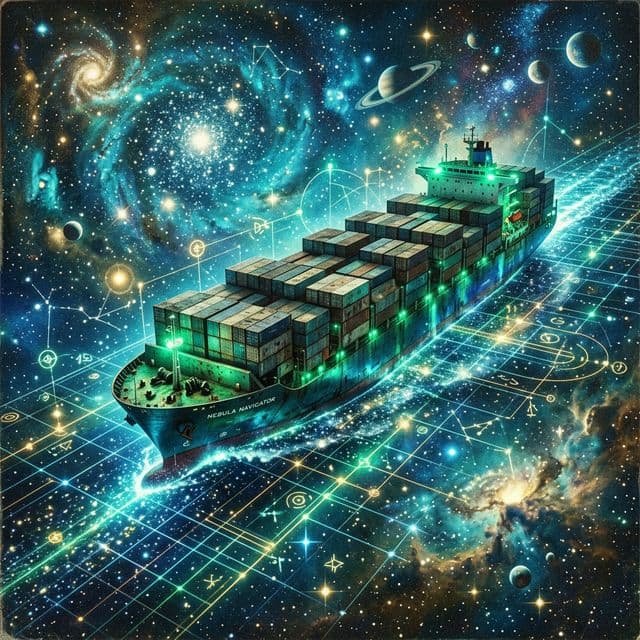
In 2026, the fragility of the global supply chain is no longer acceptable. Artificial Intelligence is completely overhauling maritime logistics, transforming massive "dumb" steel vessels into autonomous, highly connected nodes in a hyper-optimized global network.

1. Autonomous Navigation and Dynamic Routing

The ocean is an inherently unpredictable environment.

  • Algorithmic Wayfinding: Modern cargo vessels no longer sail in straight lines. AI navigation engines continuously ingest live data regarding ocean currents, wave height, changing wind resistance, and micro-weather patterns. The AI dynamically adjusts the ship's heading and engine output minute-by-minute. By riding favorable micro-currents and subtly dodging incoming storms, the AI can reduce fuel consumption by up to 15% on a trans-pacific voyage, saving shipping conglomerates millions of dollars per trip and drastically reducing carbon emissions.
  • The Rise of the Ghost Ship: Taking human error out of oceanic navigation is a priority. We are seeing the deployment of fully autonomous, crewless cargo ships. Outfitted with 360-degree LiDAR, thermal imaging, and sonar, these AI-driven vessels navigate congested straits and avoid collisions mathematically, monitored remotely by a handful of operators sitting in a control room thousands of miles inland.

2. Predictive Port Operations

A ship arriving at a destination is only half the battle. If the port is congested, the ship drops anchor and burns fuel for days waiting for a berth—a massive financial loss.

  • Just-In-Time Arrivals: AI platforms coordinate the entire logistics chain from end-to-end. Instead of a ship rushing across the ocean only to wait outside Los Angeles for a week, the AI communicates with the port's autonomous cranes, the local rail schedules, and millions of connected shipping containers. The AI calculates exactly down to the hour when a berth will be available and artificially slows the ship down mid-ocean. It arrives exactly on time, "Just-In-Time," completely eliminating port idling.
  • Smart Containers: Individual shipping containers are now equipped with edge-AI and IoT sensors. If a container full of pharmaceuticals detects a temperature fluctuation that could spoil the cargo, the AI immediately alerts the port to prioritize that specific container for offloading the moment the ship docks.

3. Supply Chain Resilience

The massive disruptions of the early 2020s proved that supply chains are fragile dominoes.

  • Disruption Simulation: Major logistics companies use AI "digital twins" of the entire global supply chain. They constantly run millions of Monte Carlo simulations: What happens to European electronics manufacturing if a specific canal is blocked for three days? How does a labor strike in a South American port affect coffee prices in Tokyo? The AI instantly maps the cascading effects of massive disruptions and automatically generates backup contracts with secondary suppliers, ensuring cargo keeps moving even when the physical world stops.

The Future of Freight

Maritime shipping is the invisible nervous system of the modern economy. By integrating algorithmic intelligence into the hulls of cargo ships and the cranes of massive ports, we are building a more resilient, efficient, and sustainable global trade network.

At ZharfAI, we track these macro-economic shifts closely. Artificial intelligence proves that the key to moving 200,000 tons of steel across the ocean isn't just powerful engines; it's intelligent data.

#Maritime Logistics#Shipping#Supply Chain#Global Trade#AI

Related Posts

Ready to Start Your AI Project?

Get in touch with our team to discuss how we can help your business.