The Silent Symphony: AI in Deep Space Communication and Satellite Networks
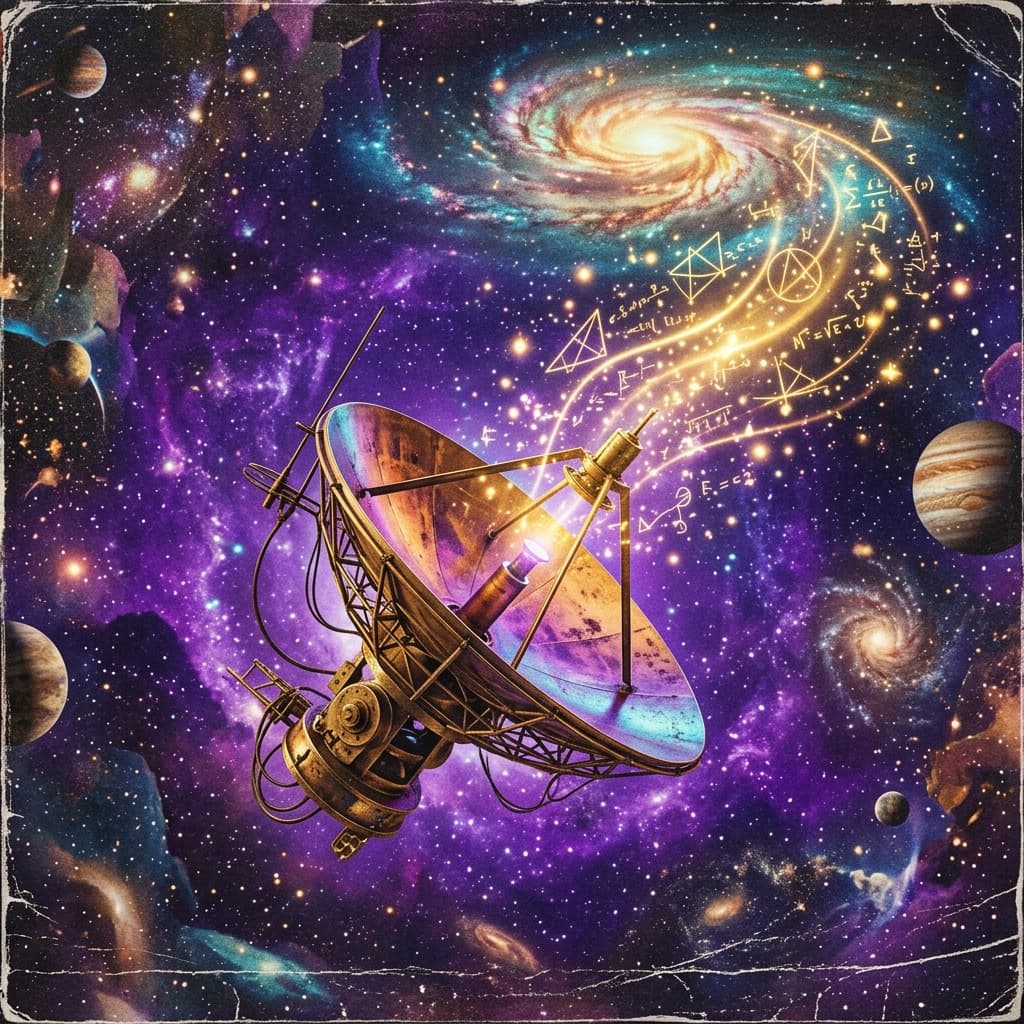
The vacuum of space is vast, cold, and incredibly noisy. When humanity sends probes to the outer edges of the solar system, communicating with them relies on bouncing faint, heavily degraded radio signals across billions of miles of cosmic radiation. For decades, interpreting these whispers required massive parabolic dishes on Earth and armies of human technicians manually filtering out signal noise.
In 2026, the infrastructure of space exploration has fundamentally shifted from hardware to software. Artificial Intelligence is acting as the ultimate cosmic translator, allowing us to maintain crystal-clear data streams with deep-space probes while autonomously orchestrating the increasingly crowded traffic of commercial satellites in Low Earth Orbit (LEO).
1. Algorithmic Signal Recovery
A photograph taken by a rover on Mars takes anywhere from 4 to 24 minutes to reach Earth, traveling as a weak radio wave constantly bombarded by solar flares and cosmic dust.
- Deep Learning Telemetry Repair: By the time a signal from the outer solar system reaches Earth, it is often heavily corrupted, with vast amounts of data packets completely lost to space weather. Traditional error correction methods simply asked the probe to resend the data, doubling the delay. Today, AI models trained on millions of hours of deep-space telemetry use generative algorithms to mathematically reconstruct the missing data packets in real-time. If a high-definition image of an asteroid arrives with 15% of its pixels corrupted by a solar flare, the AI accurately infers the missing geometry and color data, seamlessly restoring the image instantly.
2. Managing the LEO Megaconstellation
In the 2010s, there were roughly 1,500 active satellites orbiting Earth. By 2026, commercial megaconstellations (like Starlink) have placed tens of thousands of satellites into Low Earth Orbit to provide global broadband internet.
- Autonomous Collision Avoidance: Human operators can no longer mathematically manage the orbital mechanics of 50,000 objects simultaneously traveling at 17,000 miles per hour. A centralized AI now monitors the exact trajectory of every satellite and piece of space debris larger than a golf ball. The AI runs billions of physics simulations a second. If it detects a 0.01% chance that two satellites will collide in three days, it automatically negotiates the minimal orbital adjustments required, directly instructing the appropriate satellite to fire its thrusters for exactly 0.4 seconds to alter its path safely, entirely without human intervention.
- Dynamic Bandwidth Routing: As an airliner flies over the Atlantic Ocean, its passengers demand high-speed internet. AI dynamically routes the data requests across the mesh network of satellites passing overhead. The AI calculates exactly which satellite has the most available bandwidth based on its current position relative to population centers on the ground, handing off the connection from satellite to satellite every 90 seconds with absolute, imperceptible continuity.
3. Cognitive Radio and Deep Space Networks
The Deep Space Network (DSN) relies on a limited number of massive antennas on Earth. Scheduling which probe gets to "talk" and when is a logistical nightmare.
- Sentient Antennas: By utilizing "Cognitive Radio," AI allows space probes to independently adjust their transmission frequencies based on local space weather and Earth's atmospheric conditions. If an AI on a probe orbiting Jupiter senses a spike in local ionospheric interference, it automatically shifts its transmission to a clearer frequency bracket and slightly compresses its data algorithmically, maximizing the data transfer rate back to Earth while bypassing the interference.
Connecting the Void
Space exploration is humanity's highest ambition, but it is entirely dependent on our ability to transmit data back home. By applying the processing power of artificial intelligence to the immense distances of the cosmos, we are ensuring that no matter how far into the dark our machines travel, they will never be truly lost.
At ZharfAI, we believe that understanding the universe requires an intellect capable of processing its vastness. Artificial intelligence provides the mathematical bandwidth necessary to truly listen to the stars.